


This story is part of our new series of audio features - also available as long reads - made possible by the International Press Institute. If you enjoy it, leave us a comment or reply to this email with your feedback — we’d love to hear what you think.
It was a warm Monday evening in May 2021, when Orhan Inandi, a 53-year old educator and a dual Turkish-Kyrgyz citizen, left his Bishkek home and never came back. His Lexus, containing his jacket and two mobile phones, was found later that night eight kilometres away from his home.
A week later, news arrived. In a televised address, Turkey’s president, Recep Tayyip Erdoğan, confirmed that Inandi had been captured by Turkish security services and flown to Turkey.
In 2023, Inandi was sentenced to 21 years in prison for allegedly heading a terrorist organisation. And he was not the only one. That year, Turkey’s security forces confirmed the abduction of more than a hundred people in a similar fashion. Many of them, like Inandi, were teachers.
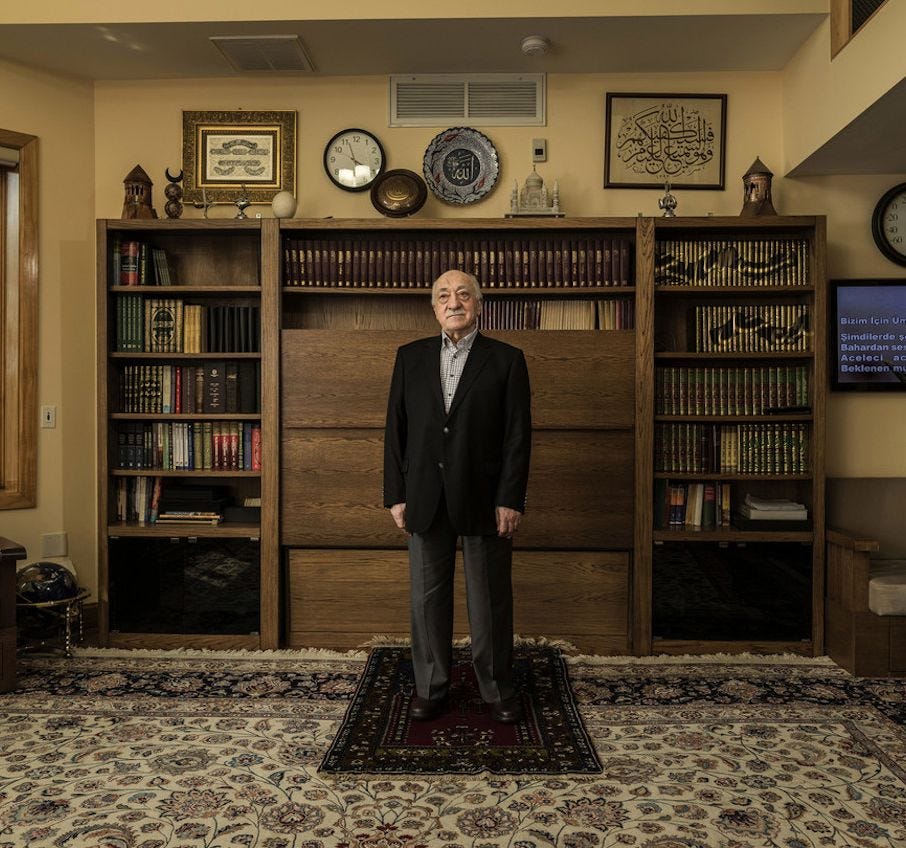
Some of them were based in Central Asia – all were connected to Hizmet – an Islam-inspired civil society initiative founded by Turkish imam Fethullah Gülen, which ran hundreds of educational institutions around the world.
Anatolian Islam
The roots of the Hizmet movement date back to the late 1960s, when its founder, Fethullah Gülen – a Turkish Muslim scholar, preacher, and a follower of the Sufi mystic Said Nursi – was a local imam in Izmir, a port city on the Aegean coast of Anatolia.
“Based on the teachings of Said Nursi, Fethullah Gülen developed his own thought within the Sufi tradition. He was quite successful as an imam in the secular parts of Turkey, where he started gathering large crowds around the mosque where he preached,” says Mateusz Chudziak, a Turkey expert.
Gülen proposed a new way of belief and religious practice, different from what was offered by Arab countries.
“It was a combination of Muslim Sufi teachings from Anatolia and Turkish nationalism, which meant being modern-oriented and cherishing Turkish identity. Gülen often said that what he spread was Anatolian Islam: tolerant, warm, and mild,” Chudziak explains.
In his teachings, Gülen promoted the idea of serving humanity as a path to becoming a better human being.
“The movement operates in three primary areas: education, humanitarian aid and philanthropy, and inter-religious and intercultural dialogue,” says Hüseyin Çelik, a Turkish journalist based in Poland.
“According to the Islamic ulema – that is, Islamic scholars – there are three main problems facing Muslims. The first is conflict, which is why organizations promoting dialogue should be established. The second is poverty, which underscores the importance of humanitarian aid.”
“The third is illiteracy, which calls for the creation of an educational movement. Gülen believed these were the greatest problems facing humanity as a whole, not just Muslims.”
Gülen’s teachings and charisma soon secured him devoted followers who were ready and able to put his ideas into practice. Thus, the Hizmet movement was born – hizmet meaning “service” in Turkish.
It was never officially formalized, remaining instead a network of loosely connected organizations loyal to Fethullah Gülen and guided by his teachings.
“On this basis, they started creating a network, contributing ten percent of their income to the community. It was composed of businesspeople, and later, media outlets and educational institutions,” Chudziak says.
“Education was a crucial point of the teachings, because only through education could pious Muslims become successful in their professional lives and enter public service. Through education, they could obtain government or state positions and change the state and its apparatus from within.”
To achieve this, Gülen and his followers set up a system of dormitories that helped students settle in towns with better educational opportunities. A new system of secondary and higher education soon followed.
The schools were gender-segregated and secular, with curricula focused on science, particularly mathematics, physics, biology, and chemistry, as well as languages, especially English, which was usually the language of instruction.
This focus made the schools highly competitive, and entrance exams were introduced to admit only the most promising students. School fees, meals, and accommodation were subsidized by Hizmet.
Over time, the schools proved extremely successful, producing students who not only excelled academically, winning school competitions across the country, but were also independent, disciplined, and well-behaved.
As Gülen often said: “You don’t teach religion; you live it.”
Global expansion
Yusuf is one of hundreds of Central Asia–based teachers wanted by Turkey as alleged terrorists, although he says he has never committed a crime. He dedicated his life to teaching and, in fact, has never held a job in his homeland, Turkey.
His story with Hizmet began when he was still a teenager.
“I studied at a technical high school outside my hometown, so I needed a dormitory. At the time, I had no information about the Hizmet movement. I took their exam and passed. I stayed in their dormitory for three years and became acquainted with the movement,” Yusuf says.
In the 1990s, when Yusuf moved into a Hizmet dormitory, the movement was on the brink of major global expansion. It followed the collapse of the Soviet Union, when Turkic-speaking Central Asian countries gained independence from Moscow.
“After the collapse of the Soviet Union, new gates to Central Asia opened. Central Asia has always been particularly important to modern Turkish national identity, as it is regarded as the cradle of the Turkish nation,” says Chudziak.
“Pan-Turanist ideas have long been strong in the Turkish mindset. Whether Kemalist, Islamist, ethnic nationalist, or Sufi, this aspect of identity was important to all.”
At the time, the newly independent post-Soviet states of Central Asia – disillusioned with Marxism-Leninism – faced an ideological vacuum and were receptive to new ideas from abroad. Envoys from the Gulf countries, the West, and Turkey arrived, each offering different visions.
Gülen’s model, with its high-quality education already tested in Turkey, proved appealing, and dozens of Hizmet schools soon mushroomed across the region.
“The schools were extremely important, but Fethullah Gülen also had political ambitions. His main goal was to raise an entire generation of well-educated people who could enter state institutions and change the system from within,” says Chudziak.
“That applied in Turkey, but when we consider the movement’s activities abroad, the idea was also to spread Turkish soft power and educate new elites who would be friendly to the Turkish Republic.”
With the establishment of new educational institutions, the movement sent hundreds of trusted members to lead schools and train local staff in the principles of Hizmet education. Yusuf was among the first to be sent.
“The dormitory director, whom I respected, became the head of a school in Uzbekistan. He suggested that I continue my higher education there, and even though I passed the entrance exam for engineering, I decided to study in Uzbekistan,” Yusuf says.
“I went there to study, not to work, but I took a part-time job as a tutor in one of the local schools. The school provided accommodation, as tutors were responsible for taking care of students after classes and at night.”
In Central Asia, the schools were a novelty. At first, neither students nor parents fully understood the philosophy behind them. What they did know was that admission was difficult and that the schools came from Turkey – a more prosperous world.
You can now support Turan Tales on Buy Me a Coffee! Get a membership or make a one-off donation to help us bring the next episodes to life
The new elite
The schools introduced students to a completely new world – one to which most children across Central Asia had no access. Students were required to live in dormitories, which fostered a strong sense of brotherhood as well as a feeling of belonging to an elite. Education at the Hizmet schools was also of the highest quality.
Laziz, now 47, works for leading international organizations in Tashkent. But in 1992, he was 15, and among the first cohort of students to join a Hizmet school in his native Bukhara, Uzbekistan. He passed the competitive science exams and was eager to attend a prestigious foreign educational institution.
“From the second year onwards, what surprised me was the very high quality of mathematics, how they taught maths, and the textbooks. The textbooks were really high quality. For example, for STEM subjects, the textbooks were imported from Cambridge and Harvard,” says Laziz.
His parents were Soviet-educated people who grew up in a secular state, without religion. But they didn’t mind that their son was learning the basics of Islam.
“They were like: these new guys are coming, educated guys from Turkey, and they’re showing us a better way to live. And it was really an honour for the parents when teachers visited our homes. Once every two or three months teachers would visit. My mother would cook lots of food,” he says.
Laziz remembers his time at the Hizmet school fondly. Thanks to Turkish education, he learned a number of skills that proved useful in his further education, and later, his career.
“We studied hard to prepare for science Olympiads. I was on the roster for English.
I was given so many books in English – grammar, vocabulary – and it all paid off. Two years in a row, I was the best in Uzbekistan in English. That gave me the chance to enroll in one of the best universities in Uzbekistan without entrance exams,” Laziz says.
For Alinur, a 33-year-old marketer in commodity trading from Kazakhstan, who entered a Hizmet school in 2003, the schools instilled a strong work ethic – but also taught cooperation and helping others.
“Being a nerd at school was highly valued. If you were good at a subject, the school would really promote you. They would use you as an example for others,” says Alinur.
“You were cool if you studied hard. Another important thing was the ability to help each other, which was strongly encouraged. If you had trouble with a subject, your classmates were encouraged to study with you.”
All Hizmet school graduates I interviewed speak excellent English and are successful in life. They say this is true for most of their classmates.
“The most important thing it gave me was the ability to study and a sense of brotherhood that you carry throughout your life. It doesn’t mean I’m close friends with all my classmates, but it creates a sense that you can rely on people, because you’ve had this shared experience of relying on others and helping others thrive,” says Alinur.
Timur, now in his thirties, studied at a Hizmet school in Kazakhstan for five years in the early 2000s. He recalls that tutors – the “older brothers” who lived with them in the dormitories – played a central role in their day-to-day lives.
They were the role models that teenagers in the midst of puberty, living away from home, desperately needed. During evening talks over tea, they were the ones who taught the youth to distinguish right from wrong.
“In Turkish, it’s called sohbet. Sohbet means conversation. You have tea and talk with your tutors. Each class had its own tutors – former students who were usually freshmen at a local university,” says Timur.
“It wasn’t deeply Islamic. It was about general values that exist in Islam and in other religions: how to be a good person, how to be kind, how to contribute to society, respect your parents, respect people close to you. Don’t gamble, don’t smoke, don’t drink alcohol. Respect women and girls. And when you’re a 14-year-old boy, you absorb these things very easily. Whatever an older brother tells you, you’re likely to follow.”
Mira, a 27-year old from Kyrgyzstan, now works for a global corporation. She attended Hizmet schools for five years between 2011 and 2016. She says that religion was not imposed, but for those who wanted it, there were separate religious meetings.
Yet, even for Hizmet school students like her, the meetings had a cloud of mystery, and it was unclear whether something sinister was going on behind closed doors.
“They would sometimes select particular students to recruit into that system. Usually, they took them to houses where the sisters lived, and they read religious books there. It wasn’t common in Bishkek – I didn’t see it – but in the regions, yes. For us, it was kind of a mysterious rumour about those houses,” Mira says.
If you haven’t done so already, please support us with a paid subscription
The rumours
In Uzbekistan, the Turkish schools closed earlier than elsewhere. Islam Karimov, Uzbekistan’s first president, was suspicious of Turkey, which had given shelter to several high-profile Uzbek dissidents. He was also wary of political Islam and harshly persecuted pious Muslims. The Turkish schools, ordered to leave in 2001, were no exception.
“On the one hand, people praised the schools as elite institutions. On the other, some of my classmates ended up in prison. Some of my classmates were recruited into some so-called clubs. Representatives of those clubs came from Turkey. They were much harsher on religion than my teachers,” says Laziz.
“They promised to cover rent and food expenses, and in return, students had to follow strict religious instructions. Many of those who did, were later arrested by the intelligence services and sent to prison.”
Laziz himself also had an encounter with the security services.
“I was already working at a university, maybe in 2006 or 2007. I was enjoying an evening with colleagues, having some drinks. I received a call from a very unusual number and was invited to the intelligence service office in Bukhara,” he recalls.
“When I arrived, the officer asked if I’d been drinking. I said yes. Then he asked if I was a graduate of a Turkish school. I said yes. He said: ‘but you drink alcohol? You don’t pray five times a day?’ I said: ‘I don’t pray at all.’ He replied: ‘okay, you’re not of interest to us. You can go.’ That was it. But maybe for others – those who were different – it was more difficult.”
But apart from Uzbekistan Hizmet education flourished across Central Asia. The schools were prestigious institutions, despite the fact that rumours about their students and staff circulated widely.
Many believed that Hizmet students were a cult-like group, blind followers of Fethullah Gülen, because they lived secluded lives in dormitories and did not fully integrate into the rest of society. Some claimed that the real purpose of the schools was to seize power in Central Asian states and beyond, and to reshape the world in a way that would suit the movement.
By the late 1990s, they had expanded into the Caucasus and the Balkans and then to rest of Asia, Africa and Americas. At their peak, Gülen-inspired schools and foundations could be found across the world, in as many as 160 countries. Because they were never part of a single registered organisation, it is impossible to count them precisely, but they numbered in the thousands.
After Tashkent, Yusuf moved to Kyrgyzstan to complete his education. He enrolled in a PhD programme in linguistics and began teaching at Osh State University. But Hizmet did not forget its former member. He was invited to work as an English teacher at one of the Hizmet schools in Kyrgyzstan.
“The job as an English teacher was pretty much the same as in other public schools, except that we visited students in their homes – it was an integral part of the educational system. Compared to my previous job at the university, it was more demanding and took much more time. But it was satisfying work, and there were many seminars to improve teachers’ skills,” Yusuf says.
“I felt I was doing a great job, and the feedback from parents, and later from graduates, was very positive. Almost all of my students entered and graduated from universities in Kyrgyzstan and around the world.”
After years of living in Central Asia, Kyrgyzstan began to feel like home. Yusuf never worked in Turkey; it was Tashkent, and later Osh, that shaped who he became.
“It was easy for me to work in Kyrgyzstan, and I got along well with people. Unlike some other students from Turkey, who preferred to stay with their compatriots, I spent time with Kyrgyz people during my studies. At the schools where I worked, I mostly taught English, ran extra classes for weaker and stronger students, and guided them as they prepared for university entrance exams,” Yusuf says.
In time, Yusuf met a Kyrgyz woman he fell in love with and married. He was in a good place. He lived in Bishkek and maintained ties with the Turkish embassy at a time when Turkey, in the 1990s and early 2000s, actively supported the development of Hizmet schools around the world – if not financially, then at least rhetorically.
A downward spiral
The first cracks in that relationship appeared in 2011 and 2012, during secret negotiations between Turkish intelligence and the Kurdistan Workers’ Party (PKK) – a militant Kurdish organisation that waged a decades-long insurgency for Kurdish rights, autonomy, and independence, primarily within Turkey.
Gülen’s supporters favoured a more security-oriented approach to dealing with the group. In response to the negotiations, prosecutors and police officers believed to be loyal to the Gülen movement launched large-scale investigations into Kurdish activists, arresting thousands. But the rift between the Gülenists and Erdoğan’s vision of the state ran deeper.
“They were unhappy with Erdoğan’s consolidation of power. Erdoğan was tolerated as long as he was prime minister – a technocrat, primus inter pares. But when he began constructing an authoritarian system, conflict emerged within the Turkish elite. After the Gezi Park protests in 2013, media linked to the Gülen movement sharply criticised the government,” says Chudziak.
“Six months later, they launched a major anti-government campaign centred on corruption allegations, directly targeting Recep Tayyip Erdoğan and his son. They published recordings allegedly discussing the concealment of large sums of money. That was the first clear signal to Erdoğan that the Gülen movement had become an enemy within.”
Soon after, a crackdown on Gülen-linked companies and organisations began. Authorities shut down schools and media outlets associated with the movement, including Zaman, once the country’s highest-circulation newspaper.
But the worst was yet to come.
On the evening of 15 July 2016, a faction within the Turkish Armed Forces attempted a coup to overthrow President Erdoğan and his party, citing disregard for human rights and democratic rule. They tried to seize key locations in Ankara, Istanbul, and elsewhere, but failed after forces loyal to the government defeated them.
That same night, Erdoğan claimed he had evidence linking the coup plotters to the Gülen movement – a charge Gülen strongly denied. Hizmet, and its various manifestations worldwide, were designated by Turkey a terrorist organisation. The following morning, mass arrests and purges began.
According to the government, 40,000 alleged Gülen supporters were arrested in the first days alone, including thousands of soldiers and judges. Since the coup attempt, approximately three million citizens have been investigated and more than five hundred thousands detained on terrorism-related charges in Turkey, according to the Turkish Ministry of Justice.
If you like our work, support us with a donation or a monthly subscription
“Were all those people actually Gülenists, or were some simply students or employees of institutions linked to the movement? That remains a matter of debate. For some, it was simply a way to consolidate Erdoğan’s power. This remains highly controversial,” Chudziak says.
Today, anyone who has ever been associated with the Hizmet movement is regarded as highly suspicious.
“They are pariahs. Being labelled a Gülenist results in social, political, and professional exclusion. The movement is seen as a parallel, anti-state structure, hated by both Islamists and secularists, each for their own reasons,” Chudziak says.
The crackdown extended beyond Turkey’s borders. Following the coup, Ankara pressured Kazakhstan and Kyrgyzstan to sever ties with the Hizmet movement and close some of their most successful educational institutions – schools that had benefited thousands of Central Asian students over two decades.
At the same time, Turkey pursued individuals it believed to be part of the Hizmet movement like Orhan Inandi – and like Yusuf.
“Whenever there is a major policy change, the Turkish government finds a scapegoat. Under the Justice and Development Party, that scapegoat became the Hizmet movement,” says Yusuf.
“When relations were good, I was invited to official events at the Turkish embassy, such as Independence Day celebrations. There was a list of regular invitees from Hizmet schools. At some point, a careless reporter took that list and claimed it was a list of decision-makers in the Hizmet movement in Kyrgyzstan. Even though I never held any decision-making role, I was accused of being one of 35 alleged Hizmet leaders.”
As a result, the Turkish embassy refused to issue Yusuf any documents, including a passport.
“They never reply officially to my claims, because that would allow me to challenge them in court. This is the dilemma of the current government: they cannot provide evidence of any wrongdoing, because I, and many others, devoted our lives to teaching. So instead, they fight the Hizmet movement outside the law,” he says.
Yusuf has applied for asylum in Kyrgyzstan, but his case is still under review. He does not want to leave. This is where he built his family, raised his children, and spent all of his working life. But it remains unclear whether he will be allowed to stay. He is trapped.
“I work online and try to continue my life, but my passport has expired and I cannot officially work here. I cannot move to another country, and as an asylum seeker, I cannot get a travel document,” Yusuf said.
Post scriptum
Today, Hizmet schools are simply called Turkish schools. The curriculum has largely remained intact, but Turkish teachers – and in many cases, dormitories – are gone. The schools no longer operate as part of the Hizmet movement.
While Hizmet is not banned in Kyrgyzstan or Kazakhstan, authorities in both countries have distanced themselves from the schools’ founders in order to maintain good relations with Turkey.
But for Mira, Alinur, and Timur, Hizmet schools were formative experiences that shaped how they think about and navigate the world. They remain in touch with their former classmates through lively WhatsApp groups – they are bonded for life.
“We were kind of weird at school, I guess. When you’re a 15-year-old boy living in an all-boys boarding school, you don’t really communicate with girls. So later, when you start doing so, you might feel like a weirdo,” says Timur.
“As for the cult label – I think it’s because we stayed close for so long after graduation. It’s been almost 20 years since we finished school. I don’t think many people from other schools stay connected for that long. That’s probably why it can look like a cult.”
“There are many rumours about us. They call us terrorists, crazy people. And because schools were gender-segregated, people assumed we couldn’t communicate with the opposite sex,” Mira says.
“Especially in Turkey, people spread rumours that Gülen was preparing us to take over the world. That we would be everywhere: in every ministry, every hospital, and secretly control everything. That’s not true. We just went there for a better quality education.”
Fethullah Gülen died in October 2024 in the United States. He was 83 years old.
This story was supported by:


