

This story is part of our series of audio features - also available as long reads - made possible by the International Press Institute. If you enjoy it, leave us a comment — we’d love to hear what you think.
A group of people carrying Chinese flags and a portrait of China’s leader, Xi Jinping, stand on the empty steppe in eastern Kazakhstan, not far from the Chinese border. “Stop the pressure and injustice against Kazakh and Uyghur peoples” and “Down with the Communist Party! Down with Xi Jinping!” they are heard saying. The protest, held in November 2025, was recorded on camera by one of the activists.
All of them are of Kazakh ethnic background and hold Kazakh passports. But most of them were born in the Chinese border region of Xinjiang, where, since 2017, China has been conducting mass-scale imprisonment, torture and Hanification of local Uyghurs and other Muslim minority groups. A policy that some human rights groups, the United States, Canada and several European countries have dubbed genocide.
By the time of the protest, China had largely dismantled the so-called re-education camps following international outcry, but repressions have not ended. According to estimates, hundreds of thousands of people still languish in Chinese prisons.
The activists are angry. In July that year, Alimnur Turganbay, a 47-year-old truck driver from Kazakhstan, travelled to China for work and was never seen again. Turganbay was born in China but left the country in 2017 and has since received a Kazakhstani passport. It soon turned out that he was arrested by Chinese authorities and imprisoned. The charges were not clear.
The protesters demanded information on his whereabouts and called for an end to repressions against Muslims in China. They put the Chinese flags and Xi Jinping’s portrait on fire.
The police arrived at the scene almost immediately, and the activists were fined for hooliganism. But shortly after, a diplomatic note from China came. It demanded Kazakhstan take harsher measures against the protesters, who, according to the note, “incited ethnic hatred.”
Kazakhstan complied. In a closed trial this April, the protest participants were charged with inciting national discord, and 11 of them were sentenced to five years’ imprisonment. Eight people were sentenced to restricted freedom, with limits put on their ability to leave their home districts. All of them are banned from getting involved in any political activity for three years.
Burning flags and portraits of leaders may not seem like a legitimate way of protesting. Still, human rights groups have called the punishment harsh and disproportionate. But Kazakhstan seems determined to support China in its fight against the three evils: religious extremism, terrorism and separatism. Even if the accusations are far-fetched – and even when the alleged perpetrators are their own citizens.
Disrupted peace
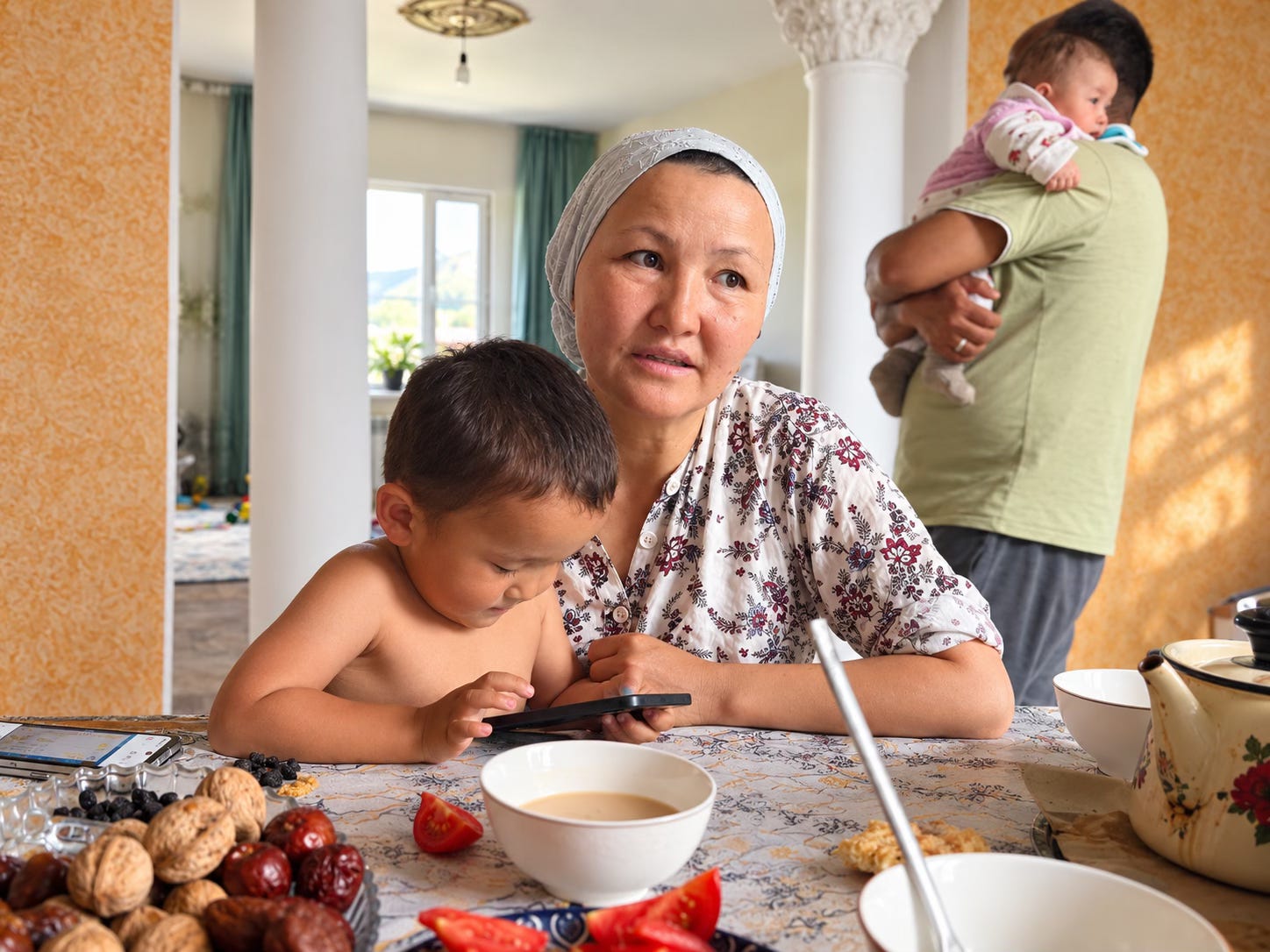
The life of Nazigul Matsukan in a small village on the outskirts of Almaty feels quiet and unadventurous. She has few neighbours, and the peaceful stillness of the landscape behind her window gives a sense of calm. She bustles about her kitchen, shifting her gaze from the pilaw cooking on the stove to her three-year-old son playing on the floor, all while carrying her three-month-old daughter. A family like many others in rural Kazakhstan. But Nazigul’s life is anything but peaceful.
In April this year, she was charged with inciting ethnic hatred following the protest at the Chinese border. The 44-year-old lawyer and customs office employee was one of eight others who were sentenced to restricted freedom. As she explains, the only reason why she did not end up in prison was her two small children, an act of goodwill on the part of the court. But she seeks to appeal the verdict. In her eyes, justice has not been served.
“We demanded to free our citizen. This was the goal. In court, I said that according to Article 174, inciting ethnic discord should be the goal. And what was the goal of our action? We did not say that Chinese people should be killed or something. We didn’t say anything about the Chinese people,” she says agitated.
“We have the right to freedom of speech, we have the right to say that Xi Jinping is bad, and say that the Chinese Communist Party is conducting a genocide. This is a fact. We have the right to say that, and this is not a crime.”
You can support Turan Tales on Buy Me a Coffee! Get a membership or make a one-off donation to help us bring the next episodes to life
Nazigul is angry, but also heartbroken. This is not a treatment she expected from Kazakhstan, her homeland, although an adopted one. She was born in China’s Xinjiang, but moved to Kazakhstan in 1999 amid a wave of enthusiasm among ethnic Kazakhs to live among their own, in a country where they would be the majority.
Historically, Kazakh nomads lived in the lands spanning today’s Kazakhstan and Xinjiang and moved between pastoral lands depending on the season. The free movement was interrupted in 1883, when the Chinese Qing and Russian empires signed a border agreement, dividing Kazakh lands between two great powers and disrupting the traditional life of the nomads.
“The border was drawn kind of randomly in the eyes of Kazakh people who were going back and forth,” says Ujin Kim, an anthropologist studying Kazakhs.
“Some people in northern Xinjiang lost their summer pastures on the Russian side of the border but kept the winter pasture on the Chinese side. They had to recreate their seasonal migration route and create a new summer pasture in the Chinese territory.”
When the Soviet Union arrived on the Kazakh lands, the goal was to turn local nomads into Soviet people. As a result of Soviet collectivisation efforts, which included confiscation of animals, the source of livelihood for the nomads, in the 1930s, the nation faced a brutal famine. Between 1.5 and 2.5 million people lost their lives in a tragedy referred to as Asharshylyk. At that time, hundreds of thousands of Kazakhs fled to Chinese Xinjiang to escape starvation.
But the situation of China-based Kazakhs soon deteriorated, too. The Chinese Communist Party’s Great Leap Forward programme involved the seizure of private lands and forced peasants into production jobs. The few farmers that remained had most of their crops confiscated by the state. This resulted in a mass famine, akin to that in Soviet Kazakhstan.
It was particularly severe in Xinjiang, a land Kazakh activists still refer to as East Turkestan. When rumours spread that the Soviet-Chinese border would soon close due to hostility between the rival communist powers, in the beginning of the 1960s, 60,000 Kazakhs crossed into the Soviet Union.
The family of Nazigul’s uncle, her father’s brother, was among those who moved to Soviet Kazakhstan. But the majority of China-based Kazakhs never left their place of residence. They had been occupying the same lands in Xinjiang for centuries, amid shifting borders and systems.
New homeland
When the Soviet Union collapsed, the newly independent Kazakhstan wanted to shift the ethnic balance within the country and invited Kazakhs from across the region, including China, Mongolia and Uzbekistan, to move to their titular homeland and help to build a new Kazakh state.
“Today, Kazakhs make up about sixty percent of Kazakhstan’s population, but back in the early nineteen nineties, it was less fifty percent and national identity was too weak,” says Kim.
But as the expert explains, not all the Xinjiang Kazakhs felt welcome in their homeland.
“The fact that Xinjiang Kazakhs didn’t experience the Soviet Union is not only important for them but also for local Kazakhs, who tend to think that the majority of Kazakhs from China are the ones who left the Soviet Union in the 1920s and 1930s when they were having such a hard time. In their eyes, Xinjiang Kazakhs are betrayers,” he says.
“That partially explains the dislike towards Kazakhs from China who are generally seen as strangers rather than co-ethnic brothers and sisters. They lack the experience of the Soviet Union and are hard to relate to. Xinjiang Kazakhs here often perceive it as discrimination. They don’t feel accepted wholeheartedly. They were thinking they were moving to their fatherland, but somehow are foreign both in China and Kazakhstan. It’s a big disappointment.”
The language used by the Kazakh authorities did not help the situation. In the 1990s, Xinjiang Kazakhs relocating to Kazakhstan were referred to as “Oralman,” which means the ones who return. This further increased the suspicion among the local population. Eventually, the government began to use a different term to describe the group: Qandas – blood brothers.
“For many Xinjiang Kazakhs I know, China is not their country, so as long as you have a very good reason to stay in China, you would rather move to Kazakhstan. Around 300,000 have done that, around one-fifth of Xinjiang Kazakhs,” Kim says.
“They were encouraged to settle in the north so that the northern regions would be more Kazakh ethnically. They were offered monetary benefits, vocational training and land not available for local people. It seemed like a lot, especially in the beginning.”
But the majority of Qandas did not want to live in the mostly Russian-speaking north. They preferred to settle around Almaty or Astana, places where they could speak Kazakh. Nazigul was 15 when she moved to Kazakhstan. She and her family adapted quickly: she soon found friends among the locals and learned Russian, received a Kazakhstani passport, and renounced her Chinese citizenship.
She went on to study law in Almaty and was accepted for the prestigious Bolashak programme, a government scholarship, to study international law at a university in Shanghai. Upon returning to Kazakhstan, she got a job in the customs office in Astana. Life was good.
Back in Xinjiang, the situation was tense.
“The roots of the problems go back to the region being colonized by the Qing Empire in 1759. There have been both armed and non-armed forms of resistance going back to 1760s. A big change came in 1949, when the region was conquered by the People’s Republic of China. This was also the moment when the region changed from what you could call a dominance colony to a settler colony. Han Chinese people began to settle the region to modernize it, to develop the agriculture,” says Rune Steenberg, an anthropologist at the Palacký University in Czechia.
“That brought with it a new set of issues and problems, as the local population felt discriminated against, dispossessed, and that their resources and land were being taken away. And that led to different forms of resistance. The Chinese government has reacted to those in different ways.”
In the 21st century, the situation escalated further.
“In 2009 there were big protests in Urumqi and the government clamped down upon them violently. Then in 2010s, we saw further forms of resistance, including armed resistance by local Uyghurs especially, the government introduced maximum pressure,” Steenberg says.
If you haven’t done so already, please support us with a paid subscription
The new reality
In 2017, rumours started spreading that the Chinese government began arbitrary internment of Uyghur and other Muslim minority groups in Xinjiang. Local Kazakhs were not spared.
At the time, just like Nazigul, another Qandas was enjoying a relatively prosperous life in Kazakhstan. Serikzhan Bilash, a businessman who moved to Almaty from Xinjiang, started receiving inquiries from other China-born Kazakhs asking for help.
“In 2017 people began to come to me asking for help. I had a business operating between China, Hong Kong and Kazakhstan, so I had money to help. I began to help women who lost their husbands in China. I bought them calling cards, and food,” he says over an online call.
“The number of people asking for help was growing rapidly. One woman turned into five and by the end of the week there were twenty of them. Then 50 and next week it is already over 100 women. All of them had the same story but came from different places.”
Most men received phone calls from China requesting them to return to sign some documents, he explains. Sometimes it was about a passport, sometimes about their properties in China. Upon return, they would be arrested, their relatives threatened.
“Some of them were herdsmen, some of them were small businessmen, some were teachers, some were pious Muslims, others had no relation to religion. And all of them were being arrested,” he explains.
Soon, more information began to arrive. China was running a mass internment campaign, sending Muslim minority people to the so-called re-education camps as part of Xi Jinping’s “Strike Hard Campaign against Violent Terrorism.” The treatment of prisoners was harsh; torture was not uncommon. The goal was to make people loyal citizens of China. But repressions touched not only those who were involved in acts of resistance against the state.
“In order to end up in these re-education camps, you didn’t have to do anything that was in violation of the laws of China. You only had to be marked as suspicious, as non-trustworthy by the state. There was a whole system set up of categorizing people into trustworthy and non-trustworthy,” Steenberg says.
“There were three main reasons that people would be considered non-trustworthy. The first one was that you had contacts abroad, had been abroad, or that you had relatives abroad that you were in touch with. The second one was that you were religious, you were praying or fasting. And the third reason could be that you were using illegal apps. A lot of people were sent to camps because they had been caught using Skype, WhatsApp, or even Wikipedia.”
In 2017, Bilash set up Atajurt, which means homeland, an organisation helping the families of Xinjiang Kazakhs detained in China. Soon, dozens of volunteers joined his group, including Nazigul. It was also thanks to their advocacy that the world found out about the ordeal of Muslims in Chinese detention. Bilash began to give interviews to Western media. Thanks to international pressure and behind-the-scenes negotiations between the Kazakh and Chinese governments, more and more Kazakhs were freed from the camps. Upon their arrival in Kazakhstan, Atajurt would publish their testimonies.
One was that of Dina Nurdybai, today a 35-year-old shop owner. We’re meeting in her home in the Almaty region, a remote, peaceful area with few houses. Dina is six months pregnant. She pours us tea and welcomes me and my translator with a table full of sweets and a meal. Her two little kids play in the second room.
She was born in Xinjiang in 1992. Her childhood was peaceful and full of joy, she says. Her family lived a nomadic lifestyle, something that Kazakhs across the border have long lost amid Soviet collectivisation.
“When I was around eight or nine years old, things started to change. Before that, there were very few Chinese people in Xinjiang, but they started building railroads and lots of Chinese workers came, started opening Chinese cafés and restaurants,” Dina explains.
“I’m the last generation that was educated in Kazakh. I learned in Kazakh in primary school, and the rest of my education was in Chinese. Now, Chinese starts already in the kindergarten.”
Survivors
From a young age, Dina has had an entrepreneurial drive. She was passionate about fashion and learned how to sew. She founded a company selling clothes and had her own workshop in China: 400 square metres, two shops, 30 sewing machines. Her company exported clothes to different markets, including Kazakhstan. But in 2017, problems began.
“I was found guilty because I visited Kazakhstan a lot for business. The government accused me of being nationalist,” she says.
She was arrested and put into a detention centre for 12 days. Without a formal court sentence and without access to a lawyer. It was overcrowded; inmates ate and went to the toilet in the same 20 square metres where they slept. Then she was transferred to the camp.
“We were required to sing ‘red songs’ that celebrate the government. We slept from nine in the evening, till five in the morning, but every two hours we were waking up to guard the others. We had a schedule. During the days we would sit on a dirty, wet floor, which was very cold. I was getting very sick. They made us learn these ‘red songs’ because they said, ‘You are not trusted by the government, we are holding you here temporarily, and you will be released after the government decides so, we’re making sure that you don’t leave China,’” Dina explains.
“In one district, there are seven camps. I was held and worked in each of them. In one of them we sew clothes. In the second one, we picked vegetables. And then there were prisons that were we worked as cleaners. And the amount of work we had to do was enormous.”
After one year in prison, Dina’s sentence was changed to house arrest. That day, her then boyfriend picked her up and proposed. She had a purpose in life again. But she knew that her time in China was over. Her business had been confiscated, and there was nothing that awaited her there. She had to leave.
“The house arrest time was the most difficult time for me. When I was released no one accepted me, no one wanted to talk to me, no one allowed me to their home. At that time, I wasn’t able to feel any emotions. In prison, we were subjected to medical treatments, they would put in us many drugs. This was coupled with the harsh conditions when everything is repeating every day, your days are all so similar that you don’t feel the time passing,” Dina says.
If you want to see more stories like this one, you can make a one-off donation and support our storytelling
“It all affected my psychological state. I wasn’t able to laugh or to cry because in prison you are not allowed to do either. We would just cry inside, and that affected me a lot after prison. People would try to make me laugh, but I was unable to laugh. Only after coming to Kazakhstan, after two or three years, I was able to become normal again.”
Dina arrived in Kazakhstan in 2019. She was free. But for Qandas activists, Kazakhstan was all but safe. Bilash and Atajurt felt increasing pressure.
“Kazakh security services began to threaten me. They openly told me to stop my activism. That began from 2017,” Bilash says.
“They said that I have to stop my activism, collecting video testimonies and publishing them in Western media. They said it is against article 174 of the criminal law, that it’s inciting ethnic hatred. They told me that if I don’t stop, they will deport me back to China. I said that if the Kazakh government rescues these Kazakhs who are arrested illegally by the Chinese government, I will stop. But our government never works on that kind of things.”
Other repressions followed. The government refused to register Atajurt, and the organisation had to change premises several times. But Bilash was unfazed. In 2019, he was arrested and, upon release, he stepped down as a leader of Atajurt. But the organisation continued to operate. In 2020, he was charged with inciting ethnic discord, and the security services threatened him and his family. Finally, all his accounts and assets were frozen. In early 2021, Bilash fled to the United States.
Nazigul, however, continued her activism. In 2020, she took holiday leave from her work and flew to Almaty to help in the Atajurt office. There was a lot of work. One day she saw him. A soft-spoken man with a friendly smile called Yerzad came to the office to talk about his brother, who was arrested in Xinjiang in 2017 and then sentenced to 17 years’ imprisonment. Something clicked immediately.
“Then I saw him and said straight away, ‘Let’s get married!’” she says.
They did. Yerzad built their home in Almaty, a peaceful sanctuary away from the noise and chaos of the city. Despite all the pressure, they were leading a happy life. That changed in April this year, when Nazigul heard her sentence.
Kazakhstan’s choice
While the world might have forgotten about Chinese oppression of Muslim minorities, pressure against Qandas activists in Kazakhstan continues. The stakes increased especially after the Russian invasion of Ukraine, which led Central Asian states to closer cooperation with China.
“There are certain policies that Kazakhstan has adopted that are favorable towards China in terms of signing deals on investment, infrastructure, and a visa-free regime that was introduced about two years ago,” says Edward Lemon, president of the Oxus Society for Central Asian Affairs and the co-author of Backlash: China’s Struggle for Influence in Central Asia.
“Importantly, after Xi Jinping’s visit to Kazakhstan in 2022, both Kazakhstan and Uzbekistan voted with China in the Human Rights Council at the UN to block the report that was being published on atrocities in Xinjiang. It was a signal of which side the Kazakh government had ultimately chosen to stand on.”
In May this year, Kazakhstan’s President Kassym-Jomart Tokayev urged Central Asian states to strengthen security cooperation with China to “curb the spread of extremist ideas” and recruitment into terrorist groups via the internet.
In July, a new law on Promoting Ethnic Unity and Progress came into effect in China. It legally enforces a single unified national identity and Mandarin language use across all 56 ethnic groups in the country, and criminalises opposition to state integration policies.
Xinjiang is no longer a mass internment camp, and the region has faced significant redevelopment: skyscrapers equipped with security cameras following people’s every step have covered Urumqi and other cities in the region, making it more Chinese. Xinjiang has become a new popular tourist destination, with hundreds of thousands of local and foreign tourists flocking to the area each year. Local cultures are still allowed to express themselves in food and bazaars, but only as long as they are seen as part of a larger, multi-ethnic Chinese branding.
People are no longer put into reeducation camps, but any resistance to the state, real or perceived, can easily land one in prison, and this is what happened to Alimnur Turganbay. The families of those who languish in the Chinese prison system are required to send money to maintain their imprisoned relatives. The parents of Nazigul’s husband still send monthly sums to the Chinese state to sustain their younger son.
Dina and Nazigul don’t want their children to be Chinese. They want to raise them speaking Kazakh, among their own people. But life in Kazakhstan can be tough. Due to her activism, Dina lost touch with her Kazakhstan-based family. Her relatives back in China are also afraid to speak to her. She stays connected with several Qandas families, but focuses on her own life. Both Nazigul and Dina don’t rule out moving abroad, especially following the imprisonment of their fellow activists.
As for the Qandas people, they slowly adapt to life in Kazakhstan.
“I noticed that the more recent Xinjiang migrants don’t speak Kazakh anymore, because they have been educated in Chinese since their childhood. It is going to affect their lives here. Many of them think that China is more technologically more advanced, and because of that, they see themselves as more modern than local Kazakhs,” says Kim.
“They also tend to stick together. They still use the same Chinese apps on their phones to connect with each other. They hang out in Xinjiang-style restaurants. Most of them would eventually adapt to the local culture – and become indistinguishable from the locals.”
This story was supported by: